Why This Comparison Matters
Choosing between engineered Italian oak and solid oak is not just a style decision. It is a money decision, a maintenance decision, and, in many homes, a practicality decision.
At first, solid oak often sounds like the safer long-term investment because it feels more traditional. It has history behind it, and people tend to associate it with permanence. Engineered Italian oak, meanwhile, sometimes gets treated like the newer alternative that looks good but gives something up. That is not really the full story.
Both are real wood floors. Both can last a long time. Both can look beautiful in the right home. The better value comes down to how the floor performs over the years, not just how it looks on a sample board under showroom lighting. That showroom magic can be a bit of a trickster. Real life is where the floor has to earn its keep.
What Solid Oak Does Better
Solid oak’s biggest advantage is simple: it gives you more wood to work with over time.
Because the plank is solid all the way through, it can usually be sanded and refinished more times than engineered wood. That matters if you plan to stay in the home for many years and want the option to restore the floor rather than replace it. A floor that can be renewed several times can stretch its useful life in a very meaningful way. That is one reason wood flooring continues to hold strong appeal in the housing market. In the National Association of REALTORS® 2022 Remodeling Impact Report, refinishing hardwood floors showed a 147 percent cost recovery, while installing new wood flooring showed a 118 percent cost recovery.
Solid oak also has a kind of straightforward honesty to it. It is one piece of wood, one material, one classic construction method. For homeowners who want that traditional approach and who have a stable indoor environment, solid oak still makes a very strong case.
Where Engineered Italian Oak Has the Edge
Engineered Italian oak earns its value in a different way.
According to the National Wood Flooring Association material on engineered wood flooring, engineered wood is built from several sheets of real wood veneer bonded together, and that cross-laminated construction makes it more dimensionally stable than solid strip wood flooring. In plain English, it tends to shrink and swell less when moisture conditions change.
That matters a lot more than people think.
A floor does not lose value only when it wears out. It can also lose value when it becomes annoying to live with. Excessive movement, seasonal gaps, or boards that react too dramatically to humidity can chip away at the owner’s satisfaction long before the floor is technically “finished.” Engineered construction helps reduce that risk. In many modern homes, especially ones with strong air conditioning, dry heat, open floor plans, or wider planks, that added stability is a real long-term advantage.
The Biggest Misunderstanding About Engineered Flooring
A lot of people still assume engineered flooring cannot be refinished. That is too broad, and it leaves out an important detail.
Some engineered floors do have thin wear layers and limited long-term refinishing potential. But higher-quality engineered products are a different story. NWFA’s refinishable standards state that factory-finished smooth engineered wood flooring needs a minimum wear layer of 2.5 mm, and unfinished smooth engineered wood flooring needs 3.2 mm to qualify under the program’s minimum thresholds.
That means engineered flooring is not automatically a short-life product. The real question is not “engineered or solid?” The better question is “how well is this particular engineered floor made?”
That is where many buyers go wrong. They compare premium solid wood to cheap engineered flooring and declare solid the winner. Then someone else compares premium engineered flooring to bargain solid wood and declares engineered the winner. Both comparisons are crooked. Quality matters more than the label on the box.
Why Italian Oak Changes the Conversation
Italian oak is often chosen for a reason that goes beyond basic durability. It tends to fit the kind of look many homeowners want today.
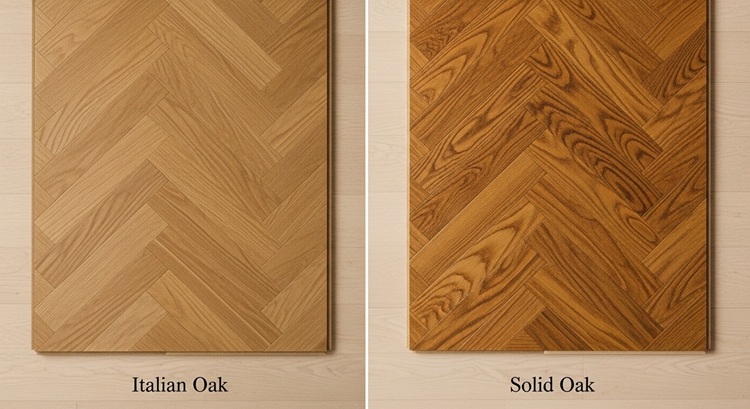
Italian and European oak floors are usually prized for their calmer grain, softer visual movement, and more refined color character. They often work especially well in modern homes, transitional interiors, and spaces where the goal is warmth without a heavy or overly rustic look. That visual staying power matters. A floor that still feels current and attractive ten years from now has delivered long-term value even before you start talking about sanding schedules and resale math.
This is where engineered Italian oak becomes especially compelling. Many of the Italian oak products people want come in wider planks and more design-forward finishes. Engineered construction supports that format well because it helps control movement better than solid wood in wider boards. So the material is not just helping performance. It is helping deliver the exact look people are often trying to buy in the first place.
A Real Example, Oak Turin
A good example is Oak Turin.
Bergamo Floors describes Oak Turin as an Italian-made engineered European white oak floor. The product page lists it at 5/8 inch overall thickness, 7.5 inches wide, with a 4 mm veneer and a matte polyurethane finish. It also describes the color as earthy and neutral, with a look designed to suit both modern and classic interiors.
That matters because those specs tell you this is not a thin, entry-level engineered floor pretending to be premium. A 4 mm veneer is substantial. The 7.5-inch width supports the wide-plank European look many homeowners want. The Italian-made construction and engineered format point toward a floor designed to balance appearance with long-term practicality. For someone who wants an Italian option that looks refined but also makes sense for everyday living, Oak Turin is the kind of product that shows why engineered Italian oak has become such a serious category.
What Long Term Value Really Means
People often define long-term value too narrowly.
It is easy to assume the best value always comes from the floor with the longest theoretical lifespan. But value is not just about how many decades a product could last under ideal conditions. It is also about how it performs while you actually own it.
A floor has long-term value when it holds up well, looks relevant for years, fits the home, and does not create extra problems. It has long-term value when it supports resale appeal. It has long-term value when you do not have to constantly baby it or worry about how it will react every season.
That is why engineered Italian oak often wins in real homes. It gives you real wood, a premium look, good stability, and, in better products, meaningful refinishing potential. Solid oak still has the edge in maximum sanding life, but engineered Italian oak often offers the better balance.
So Which One Gives Better Long Term Value
If your top priority is getting the most possible refinishing cycles over several decades, solid oak still has the advantage. In a stable environment, with the right installation area and the right expectations, it remains an excellent long-term choice.
But for many homeowners, high-quality engineered Italian oak gives better overall long-term value.
It tends to perform better with humidity changes. It supports the wide-plank European look many buyers want. It can offer real refinishing potential when the wear layer is thick enough. It also delivers a blend of beauty and practicality that fits the way people actually live now.
So the honest answer is this: solid oak wins on maximum lifetime sanding potential, but engineered Italian oak often wins on the full package. And in the flooring world, the full package usually decides whether a purchase feels smart ten years later or turns into an expensive lesson wrapped in pretty wood grain.